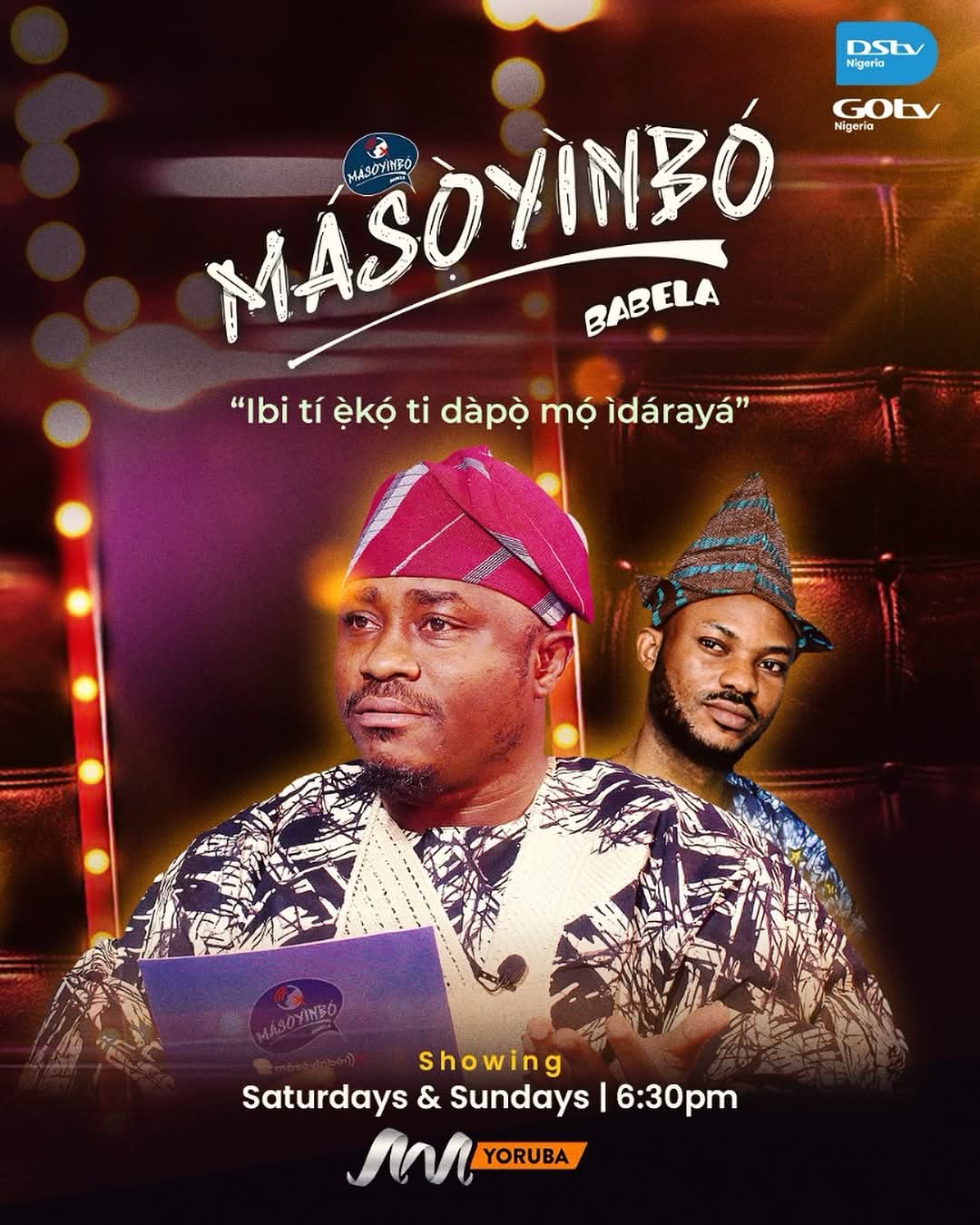
Masoyinbo Yoruba Pride lives on through a bold game show that challenges contestants to speak only Yoruba, reigniting fluency and love for the language
In an era where English dominates Nigeria’s urban discourse, a cultural game show has emerged to remind (and challenge) Yoruba speakers of the richness of their mother tongue.
Also read: The Return of the Alaafin: A Personal Reflection
Masoyinbo, which literally translates to “Don’t Speak English,” is the brainchild of Yoruba etymologist, Olalekan Fabilola.
And with over 120 episodes aired, it has quickly become one of the most distinctive cultural experiments on Nigerian television.
The premise is deceptively simple: contestants must answer 10 questions strictly in undiluted Yoruba.
Any English word uttered, no matter how small or habitual, costs them money. Words like “okay,” “yes,” “sir” or “thank you” are marked down, leading to loss of marks.
The difficulty of the challenge is part of its brilliance, and a large part of its charm.
Since the show began, no contestant has walked away with the coveted ₦1 million grand prize. And the show is getting phenomenally popular by the day, with its ratings hitting the roofs in Q2 of 2025.
The highest so far won is ₦250,000, and that was by Adesola Adekunle in the 81st episode.
The show has drawn celebrities like Funke Akindele, Falz, Saheed Osupa, and Cute Abiola, but none has conquered its strict rules.
…to educate people and make them confident in their mother tongue.
And that is probably the point.
Though many are Yorùbás, but can hardly communicate in undiluted Yoruba sentence without throwing in English words.
Masoyinbo has exposed this quiet erosion of fluency, playfully.
Beyond entertainment, the show has grown into a cultural movement. It is streamed online and aired on traditional platforms, with episodes regularly going viral on Instagram, TikTok, and YouTube.
One of the most talked-about editions aired in May 2025 during Children’s Day celebrations.
Hosted by Àjàdí, the special episode was tailored to young learners and families, and sparked a wave of positive reactions. Viewers praised it as both fun and educational.
But perhaps the greatest value of Masoyinbo lies in its timing. At a moment when Nigerian pop culture is being exported globally, there is a quiet anxiety at home about what is being lost in translation.
Masoyinbo reaffirms that language is a vessel of memory, emotion, and worldview.
The show’s brainbox, Olalekan Fabilola, said in a recent interview that the show was created not just to entertain, but “to educate people and make them confident in their mother tongue.”
According to him, his goal is to make Yoruba “something to be proud of again.”
Not a few agrees that he is succeeding. The game show has turned linguistic fluency into a badge of honour.
Also read: These Nigerian Creatives Are Redefining Identity Internationally
It rewards knowledge of idioms, proverbs, and rhythm. It exposes gaps in usage that even native speakers didn’t know they had. And it does it all with joy, mischief, and seriousness wrapped in laughter.